The Aesthetics of Asymmetry in Japanese Culture: The Spirit of Ceramics and Ikebana
Japanese culture possesses a distinctive aesthetic sensibility that does not regard perfect symmetry and balance as the sole ideals of beauty. Instead, it embraces values that may be described as the beauty of imperfection, the beauty of empty space, and the beauty of asymmetry.
In many Western artistic traditions, symmetry and geometric balance have often been regarded as fundamental principles in architecture, garden design, and the visual arts. In contrast, Japanese aesthetics developed from the recognition that perfect symmetry rarely exists in nature. Rather than pursuing absolute balance, Japanese artists have long sought to create harmony through deliberate irregularity and subtle imbalance.
One of the most representative expressions of this philosophy can be found in ikebana, the Japanese art of flower arrangement.
In ikebana, flowers are rarely arranged symmetrically. A single branch may stretch dramatically upward toward the sky, while another is placed lower and more modestly. Each element extends in a different direction, yet together they create a quiet and profound harmony (Photo 1).
Because ikebana values the natural character of plant materials, wildflowers and native grasses are often preferred. Rather than imposing excessive human intention upon nature, the goal is to reveal and enhance the inherent beauty already present within each plant. Equally important is the space created between the flowers themselves. This negative space, known as yohaku (empty space), forms an essential component of the composition.
For centuries, the Japanese have perceived within this empty space the movement of wind, the presence of the seasons, and the pulse of life itself. Ikebana is therefore not merely a technique for arranging flowers; it is an art form that embodies coexistence with nature.
This way of thinking is deeply connected to the worlds of the tea ceremony and ceramics.
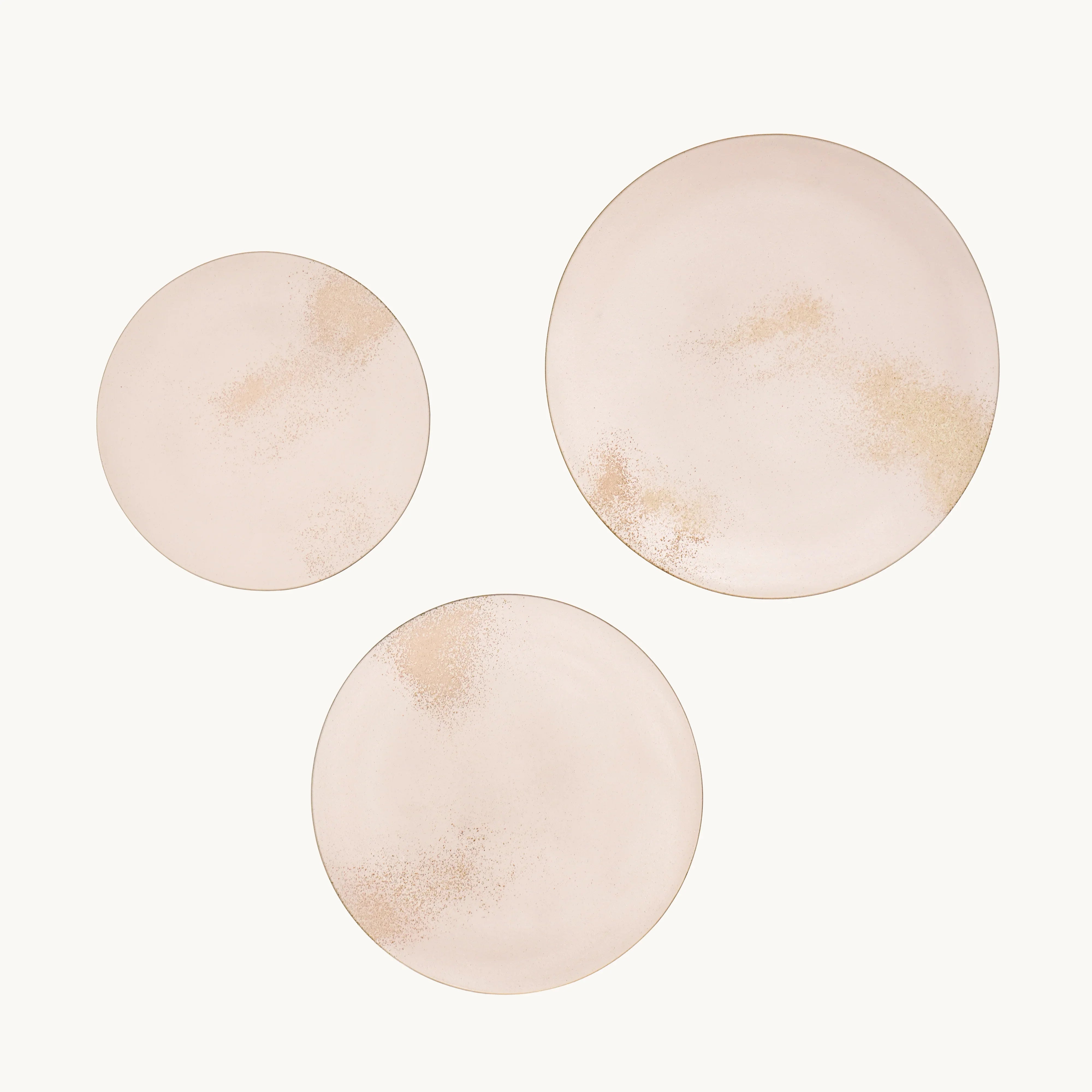
Tea masters have long appreciated the variations of color that emerge on ceramic surfaces, the kiln effects (yohen) seen in Bizen ware (Photos 2 and 3), the fine crackle patterns (kannyu) characteristic of Hagi ware (Photo 4), the natural texture of clay (Photos 2 and 3), and the spontaneous flow of glaze (Photo 5). Collectively, these features are referred to as keshiki, literally meaning “landscape.” They are appreciated much like one would admire a natural scene.
A ceramic vessel is not considered merely a utilitarian object. Rather, it is a unique creation born from earth and fire, and the accidental qualities embedded within it have long been regarded as a source of beauty.
This philosophy is especially evident in the form of Japanese tea bowls.
Many Japanese tea bowls are intentionally asymmetrical. Some have slightly distorted rims (Photo 6, Karatsu ware), while others feature subtle bulges or depressions in their bodies. Examining celebrated examples such as Oribe tea bowls (Photo 7) and Raku tea bowls (Photo 8), one quickly realizes that they are not perfectly circular. Instead, they possess carefully controlled irregularities.
These characteristics are, of course, not the result of technical inadequacy.
By introducing small imbalances and subtle variations, potters imbue their works with a sense of human presence and the breath of nature. Through these irregularities emerges the aesthetic world of wabi and sabi. For generations, tea practitioners have discovered depth, character, and beauty not in perfection, but in imperfection.
Japanese ceramic culture also embraces the idea that time itself possesses beauty.
Unglazed stonewares such as Bizen ware develop increasing richness and luster through use, as though the vessel itself were maturing and growing. In Hagi ware, tea gradually penetrates the fine crackle patterns, producing distinctive changes over the years.
In many Western traditions, cracks and discoloration may be regarded as signs of deterioration. In Japan, however, such changes have often been treasured as evidence of the vessel's history and lived experience.
Two practices that vividly symbolize this attitude are kintsugi and kasugai-tsugi.
Kintsugi (Photo 9) is a restoration technique in which broken ceramics are repaired with lacquer and the repaired seams are decorated with gold. Rather than concealing damage, the method intentionally highlights it, transforming the fracture into a new source of beauty.
Similarly, kasugai-tsugi (Photo 10) is a repair technique in which broken fragments are joined with metal staples. One of the most famous examples is the celebrated tea bowl Bakōhan (Photo 11), now housed in the Tokyo National Museum and designated an Important Cultural Property. The bowl is renowned not despite its repairs, but because its restored form itself came to be highly valued.
Rather than erasing the traces of breakage, these practices embrace the object's history and elevate it into a new form of beauty. This perspective represents one of the most original and distinctive aesthetic philosophies found anywhere in the world.
At first glance, ikebana and ceramics may appear to be entirely different art forms. Yet they share a common philosophical foundation.
Both value natural imbalance over perfect symmetry. Both cherish the process of continual change rather than a static state of completion. Both regard not only the object itself, but also the surrounding space and the passage of time, as integral parts of the work.
The empty space created by a single wildflower.
The landscape revealed by a slightly distorted tea bowl.
The traces of time inscribed within fine crackle patterns.
The repaired lines of kintsugi and kasugai-tsugi.
All of these are expressions of what may be called the Japanese aesthetic of asymmetry.
Rather than pursuing perfection, Japanese culture has long sought richness and depth within imperfection itself. This sensibility has been passed down through the traditions of ikebana, the tea ceremony, and the ceramic arts, and continues to live on today.
To coexist with nature, to embrace change, and even to appreciate the passage of time as a form of beauty: this unique aesthetic consciousness lies at the very heart of Japanese culture and stands as one of Japan's most profound contributions to the world's philosophy of beauty.
【Photo1】

【Photo2】

【Photo3】

【Photo4】

【Photo5】

【Photo6】
【Photo7】

【Photo8】

【Photo9】

【Photo10】

【Photo11】